
Tips
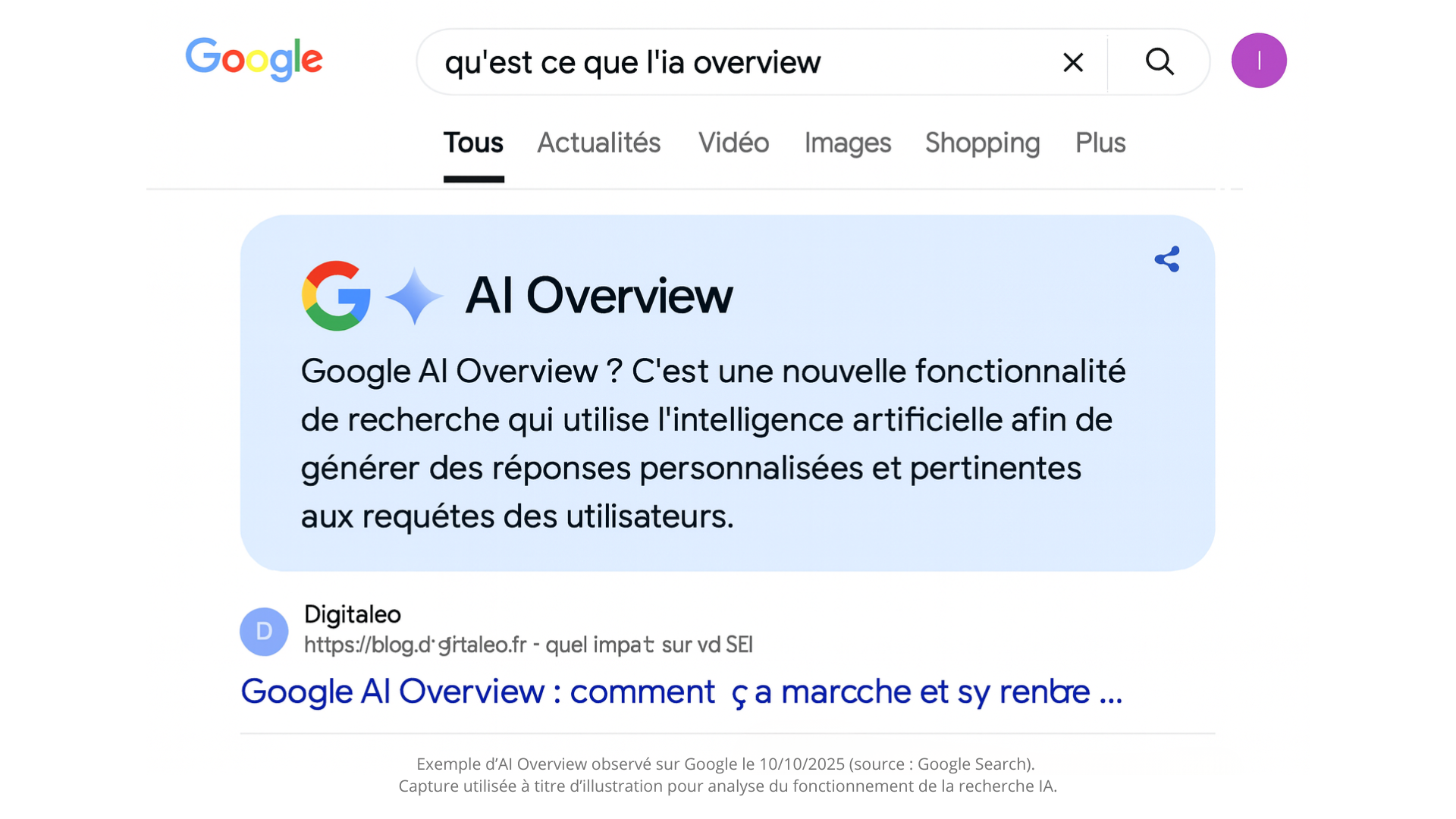
Natural referencing (SEO) is undergoing a profound transformation.
The arrival of artificial intelligence technologies such as machine learning and generative AI is redefining the way Google displays and interprets search results.
These changes directly affect the visibility of your centers’ websites and will require you to adapt your practices.
In simple terms: when you perform a search, Google no longer just shows a list of links — it now generates an AI-written summary, called an AI Overview, that synthesizes the main answers found across the web.
This block appears above traditional results and can include text, links to sources, and sometimes interactive elements.
To illustrate, imagine a search for “best restaurants in Paris.”
Instead of a simple list of websites, you might now see a Google box summarizing the top restaurants by price, cuisine type, and atmosphere — with direct links to each source.
This example shows that the format of AI Overviews can vary depending on the query.
So, it’s no longer enough to simply create web pages. You must pay very close attention to the quality of your content — and, by extension, to how well it matches your consumers’ search intent.
The more precise and differentiated your content is (for example: “What are the must-see events in Quimper in August 2025?”), the greater your chances of appearing in Google’s AI Overview.
Machine learning has become a central pillar of Google’s algorithm.
It enables the search engine to analyze massive volumes of data to better understand user intent.
The result? More relevant, personalized search results that align with real user needs.
This technology allows Google to :
The logic behind machine learning is similar to a mathematical linear regression.
Don’t worry — you don’t need to be a mathematician to master Google. You just need to understand the idea of correlation:
Google establishes a link between what a user is looking for and the information you provide.
It then tests your content — if it satisfies the user, your page will be shown more often. If not, Google will try something else.
Google now applies much more complex methods and integrates different types of AI to go even further with AI Overviews.
With a conversational approach, it’s no longer just about correlating keywords with page titles — context also matters.
Thanks to NLP (Natural Language Processing), AI can interpret intent more accurately.
For example, “best SEO practices 2025” signals a search for up-to-date Google SEO advice.
By leveraging text-generation interfaces like Gemini, Google can now produce coherent summaries.
It’s no longer about correlations between words and titles, but rather between summaries and contexts.
It’s no longer about using ChatGPT to write random articles — you must perform a semantic and intent analysis before producing content.
(If that sounds unfamiliar, you might need our help — don’t hesitate to contact us!)
With AI Overview, Google now favors:
Conversely, short, repetitive, or keyword-stuffed content is systematically devalued.
Investing in editorial quality and strategically designed content is no longer optional — it’s a prerequisite for visibility and user satisfaction.
Many avoid writing long articles thinking users won’t read them.
In reality, today’s users often only read the section that interests them — or they get a summarized version through AI, or directly from your FAQ snippets.
So, cutting down your text length is a false good idea in the age of AI.
Instead, write well-structured articles that allow both humans and AI to quickly access key information.
It’s not necessary to delete all your old content — for a simple reason:
AI crawlers (and traditional Googlebots) don’t constantly re-index your site.
Removing pages can lead to 404 errors, which are disastrous for your SEO.
A 404 means users bounce back immediately, signaling to Google that your content isn’t reliable.
It’s far better to create redirections and add dates on event-related pages.
Generative AI tools (like ChatGPT or Gemini) open up new SEO possibilities — producing articles, images, or even code in seconds.
For businesses, that’s a huge time saver.
But there are risks:
Generative AI should be seen as a support tool, not a replacement.
Human review and enrichment are essential to ensure quality and originality.
As we’ve mentioned before, whether you use ChatGPT, Gemini, or another AI, skipping keyword and intent analysis is a huge mistake.
Without that crucial step — and your own human expertise — you risk producing content that doesn’t perform because it fails to match clear search intent.
Take the time to conduct a proper semantic analysis alongside AI content generation.
To help you do this, you can rely on our AI Agent Diego, which pre-sorts local search queries to identify the most relevant ones.
Note on Diego Content Creator:
The goal of the “potential target” metric we provide isn’t to achieve the highest possible value, but to identify the most relevant keywords comparatively.
For instance: “shopping center near me” vs. “shopping mall around me.”
The rise of AI also changes SEO optimization criteria.
To stay competitive, you must now:
For our loyal users, you can find a full summary of these metrics in your Technical SEO Dashboard.
Launching an SEO strategy without consistent management is pointless.
However, you can absolutely use tools like Yourban.ai to automate routine tasks (e.g., store listings) — while simultaneously creating varied content like blog posts, Google updates, or LinkedIn articles.
Identify what you already do — then see how AI can help you do more, in the same amount of time.
At Yourban.ai, we’ve built a specialized SEO tool for physical retailers.
With our platform and expert support, you can set up a solid, sustainable SEO/AI strategy in less than three months — and unlock new growth opportunities for your business.

Tips
May 19, 2025

Trends
May 19, 2025

Trends
May 19, 2025
.png)

